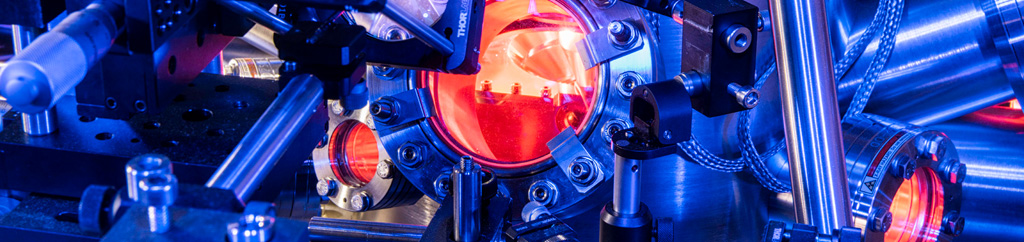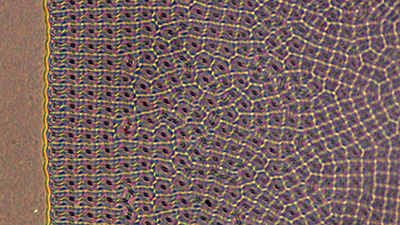
Sara Klopčič, Aljaž Kavčič in dr. Matjaž Humar from Lab for biophotonics, soft photonics and quantum optics and Condensed matter physics department at Jožef Stefan Institute and Faculty of Mathematics and Physics at the University of Ljubljana have together with Dr. Nerea Sebastian from Department of Complex Matter at Jožef Stefan Institute demonstrated, in a recently published article Electrically and Geometrically Tunable Photon Pair Entanglement from Ferroelectric Nematic Liquid Crystal, published in Advanced Science, that quantum-entangled photon pairs can be generated in ferroelectric nematic liquid crystals (FNLCs), while simultaneously allowing continuous control over the degree of quantum entanglement. This property represents an important advantage of liquid crystals over classical solid nonlinear crystals and paves the way for the development of so-called quantum displays. |
The well-attended event "Challenges and Opportunities of Slovenian Robotics," which took place on October 15, 2024, at the Four Points by Sheraton Ljubljana Mons hotel, once again confirmed that the Slovenian research and industrial community in the field of robotics is among the most recognized in Europe. The event, co-organized by the Jožef Stefan Institute and the Slovenian Robotics Association, brought together representatives of research institutions, industry, and users of robotic technologies from Slovenia and abroad. In their speeches, Prof. Dr. Matjaž Mihelj, President of the Slovenian Robotics Association, and Prof. Dr. Andrej Gams, coordinator of the European ROMANDIC project at the Jožef Stefan Institute, emphasized the importance of cooperation between research and industry stakeholders as one of the key driving forces, and the role of SRIP Factory of the Future in strengthening the innovation, research, and business capabilities of the Slovenian economy. |
Within the MAGNELIQ project (EU Horizon 2020, No 899285), researchers from the Materials Synthesis and Complex Matter Departments, with partners (Faculty of Electrical Engineering and Informatics of the University of Maribor, Prensilia, s.r.l.), developed three sensors that were recognized as important innovations by the European Innovation Council (EIC). An optical sensor for measuring electric and magnetic fields (No. 5150, All-optical external-field sensor) and rotation (No. 5152, Contactless magneto-optic rotation sensor) are based on a magneto-optical fluid embedded in an optical fiber and is suitable for use in process automation and robotics, even under extreme conditions (radiation, submarine, toxic, or explosive environments). The third sensor (No. 51047, Distributed Liquid Force Sensor) is based on a magneto-electric fluid, which enables force measurement over a large area, representing a significant improvement for robotics. |
Accurate detection of volatile organic compounds at trace concentrations holds a great promise for future health, safety, and environmental applications. In a recent Nature Communications report, Aleksander Matavž from the Condensed Matter Physics Department, together with colleagues from KU Leuven, address this challenge by introducing kinetic selectivity achievable in nanoporous crystals into the domain of chemical sensing. Their sensors measure the diffusion characteristics of adsorbed gases, which can differ by orders of magnitude even for very similar compounds. As a result, a single kinetic sensor can distinguish and quantify gases at ppm concentrations, even in mixtures with high humidity—outperforming a state-of-the-art commercial electronic nose. In addition to its applicative and market potential, the developed method represents a powerful tool for studying diffusion in thin films over a wide concentration and temperature range. |
|
 |
The Jožef Stefan Institute invites interested researchers and others to joint our teams.
Posts |
|