V001 / JSI

LinkedIn Facebook Twitter TikTok Instagram TV IJS Kolokviji IJS   | Arhiv novic | News Archive | Video arhiv |   Evropski kmetijski sklad za razvoj podeželja    Načrt za okrevanje in odpornost    Družini prijazno podjetje

Slovensko   English   2026-10-05

Foto: Arne Hodalič in Katja Bidovec

News Archive

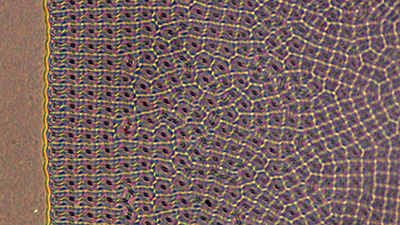
The interplay between chirality, confinement and elasticity can drive the spontaneous formation of complex polarization patterns in chiral ferroelectric nematic liquid crystals. Researchers from the Department of Complex Matter and Department of Condensed Matter Physics at the Jožef Stefan Institute, together with collaborators from the University of the Basque Country and the University of Leeds, have shown how these three factors work together to transform an initially uniform state into a variety of ordered structures. In a new study published in Advanced Materials, the researchers show that when the pitch of the material under confinement deviates from its natural pitch, periodic instabilities emerge as the material approaches a heliconical polar state. Near such transition, the bend elastic constant of the liquid crystal softens. The combination of the material’s preferred helical structure, confinement, and reduced resistance to bending drives the formation of periodic polarization patterns.

Photo: Radojko Jaćimović

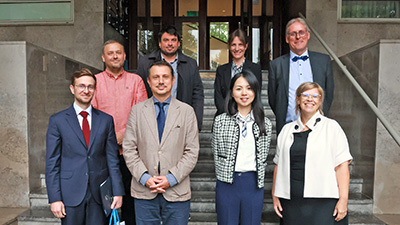
On 17 September 2026, the Jožef Stefan Institute hosted a delegation from UNESCO and the European Commission for a meeting held under the umbrella of science diplomacy. The discussions highlighted the role of scientific knowledge, research infrastructure and international cooperation in addressing global challenges. Together with representatives of the Ministry of Foreign and European Affairs, we explored how Slovenia's scientific excellence can contribute to international dialogue and cooperation. Special attention was given to artificial intelligence and IRCAI (International Research Centre on Artificial Intelligence), the UNESCO Category 2 Centre hosted at IJS, as an example of connecting science, policy and diplomacy in practice. The meeting also underlined the importance of promoting scientific facts and evidence-based dialogue. Building trust in emerging technologies starts with trust in the science, researchers and research infrastructure behind them. Science diplomacy helps turn this trust into partnerships that connect knowledge across borders.

News Archive

Biofilms – highly organised microbial communities – are often the hidden cause of recurrent infections in humans and animals, as well as contamination in food and pharmaceutical production. As these communities grow into 3D structures, microscopy is becoming increasingly important for their investigation, while imaging data processing requires multidisciplinary expertise. At the IJS, through collaboration between three departments (Biotechnology – B3, Knowledge Technologies – E8 and Condensed Matter Physics – F5), we have developed a new tool for analysing biofilm images called MicroICS, currently the only tool that combines analysis of confocal fluorescence images of biofilms with machine learning. It consists of three modules: the first converts images into quantitative structural features; in the second, we train models to understand how these features relate to the biological context; and in the third, we use the trained models to predict and classify new images. We have published an article on its development and functionalities in the journal npj Biofilms and Microbiomes.

News Archive

Sana Saeed from the Department for Nanostructured Materials at the Jožef Stefan Institute received the Best Poster Award at the CAMD Summer School 2026, held from 16 to 21 August 2026. Her poster, “Ab-initio and STM Investigation of the Nd₂Fe₁₄B Surface,” presented a combined experimental and computational study of the (001) surface of neodymium–iron–boron, an important material for high-performance permanent magnets. Using scanning tunneling microscopy, low-energy electron diffraction, and density functional theory simulations, the research identified an ordered surface reconstruction with a periodicity of 12.41 Å. The agreement between experimental and simulated STM images supported a reconstructed Nd-rich surface model. The work was carried out in collaboration with researchers from the Institute Jean Lamour in Nancy, France. This award recognizes the scientific quality, relevance, and presentation of the research and strengthens the international visibility of materials research conducted at the Jožef Stefan Institute.

IN FOCUS


STRATEGIC PROJECTS

Strategic Projects


COLLOQUIA

Colloquia


VIDEO ARCHIVE

Video Archive


PRINTED NEWS

Printed News


GENDER EQUALITY AT JSI

Gender Equality at JSI


DAYS OF JOŽEF STEFAN

Days of Jožef Stefan


FOOD AT JSI

Food at JSI


JOB OPPORTUNITIES

Job Opportunities

The Jožef Stefan Institute invites interested researchers and others to joint our teams.
Posts


PHD PROGRAMMES

Postgraduate School

The JOŽEF STEFAN INTERNATIONAL POSTGRADUATE SCHOOL, in collaboration with the INSTITUTE JOŽEF STEFAN, begins enrollment for doctoral and master's degrees.

J. Stefan Institute, Jamova cesta 39, 1000 Ljubljana, Slovenia, Telephone: +386 1 477 39 00
info@ijs.si