
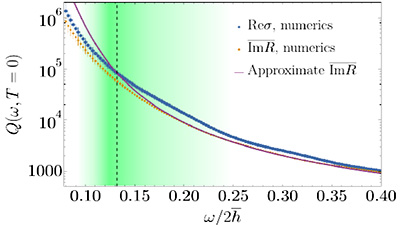
Disordered superconducting materials are widely used in quantum devices—qubits, microwave resonators, photon detectors, and more. Their performance is limited by unexplained energy loss at low temperatures. Prof. Mikhail Feigelman of the Department of Complex Matters, together with his colleague Anton V. Khvalyuk, has developed a new microscopic theory that explains how energy loss depends on temperature (T) and frequency (ω) under typical operating conditions, when both T and ω are low compared to superconducting energy scales. The key discovery, published in the journal Physical Review Letters, is that losses are dominated by localized collective modes arising from irregularities in the superconducting state—another manifestation of disorder. The energy loss to these modes increases rapidly with frequencies and decreases with temperature—an unusual consequence of the local structure of these modes. The theory explains recent experiments on thin films of materials such as indium oxide, titanium nitride, and niobium nitride, and points to practical strategies to reduce energy loss in quantum hardware.