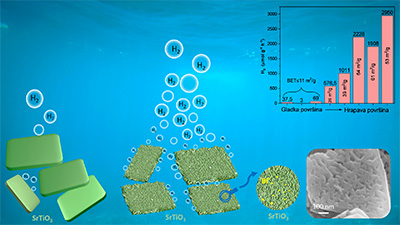
The research group of the Advanced Materials Department at the Jožef Stefan Institute, in collaboration with researchers from the National Institute of Chemistry and National Taiwan University, has published a new article in the Chemical Engineering Journal entitled: Steering the Bi₄Ti₃O₁₂-to-SrTiO₃ hydrothermal transformation for controlling the functionality of two-dimensional (2D) SrTiO₃ nanoplatelets for photocatalytic H₂ evolution. The work provides an in-depth understanding of how 2D Bi₄Ti₃O₁₂ nanoplatelets can be transformed, via low-temperature hydrothermal processing, into 2D SrTiO₃ nanostructures with tailored surface roughness and surface-trapped monoatomic bismuth species. These features significantly enhance photocatalytic hydrogen evolution, achieving more than a 50-fold increase in efficiency compared to their smooth-surfaced counterparts. The study not only demonstrates how to engineer the functional properties of SrTiO₃ nanoplatelets, but also opens new pathways for designing other 2D perovskite nanostructures derived from Aurivillius phases through low-temperature topochemical transformations. This work represents a contribution to the HetCat project under the M-era.NET initiative.