Passive heat transfer in small and modular reactors
Pasivni prenos toplote v malih in modularnih reaktorjih
Project code and title
L7-70126
Passive heat transfer in small and modular reactors
- Ivo Kljenak (R4)
ARIS and other co-funders' logos


Project team
- Project leader: Ivo Kljenak
Participating research organizations:
Odsek za reaktorsko tehniko, Institut Jožef Stefan
Project team composition:
Ivo Kljenak, Iztok Tiselj, Andrej Prošek, Janez Kokalj, Zoran Petrič, Matej Tekavčič, Leon Cizelj, Aljoša Gajšek
Project description
Small Modular Reactors (SMRs) offer a promising option for expanding the usability, versatility, reliability and safety of nuclear power in the future. Many proposed SMR designs incorporate passive safety systems that can provide important safety functions, including heat removal during accident conditions. By requiring limited external power, system support and operator actions, these systems have the potential to provide a high level of reactor safety and reliability. However, the thermal-hydraulic phenomena governing their performance are often driven by relatively small forces, making them difficult to model accurately and creating uncertainties in safety analyses.
Therefore, the project aims to improve the understanding and modelling of passive heat transfer phenomena in light-water SMRs. Using Computational Fluid Dynamics (CFD) and thermal-hydraulic system codes, the project will simulate experiments representing key passive safety systems on both the local and system scale, assess the capability of current modelling approaches and identify critical gaps in existing models. Particular attention will be devoted to steam condensation in safety condenser tubes, external cooling of the reactor pressure vessel and gravity-driven safety injection from accumulators.
Simulation results will be validated against experimental data generated within the European EASI-SMR project. The research will support the refinement of existing heat transfer models and enhance the reliability of simulation tools used for SMR safety analyses. The developed and validated models will serve as building blocks for future digital twins, supporting the design, assessment and safe operation of small modular reactors.
Work programme
The work programme is divided into three parts, each focusing on a key phenomenon relevant to passive safety systems of small modular reactors (SMRs). The work combines CFD simulations using OpenFoam, system-level thermal-hydraulic simulations using RELAP5 and experimental data available through the European EASI-SMR project.
1. Steam condensation in a classical safety condenser tube
Goal: To characterize and model steam condensation and heat transfer in safety condenser tubes under conditions relevant to SMR passive safety systems.
Two sets of experiments in the SACO facility will be simulated. The first, performed in the COSAC condensation tube, covers a broad range of steam pressures and temperatures and will be used to compare experimental heat-transfer data with system-code predictions. The second, performed in the PRECISE condensation tube, provides high-resolution data for validation of system and CFD models of film condensation, including conditions with and without non-condensable gases. The analyses will help to distinguish uncertainties related to condensation and cooling from those associated with boiling in the surrounding pool.
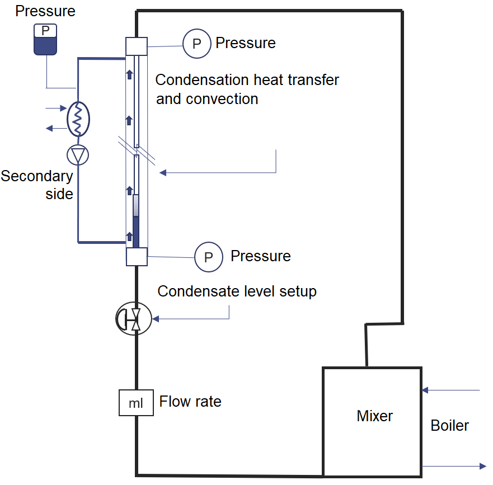
Figure 1: SACO experimental facility for steam condensation studies
2. Reactor pressure vessel external cooling
Goal: To analyse external cooling of the reactor pressure vessel (RPV) under in-vessel retention (IVR) conditions and assess the capability of computational models to reproduce experimental results.
The experiments investigate external cooling of the RPV under pool boiling and thermosiphon conditions. CFD simulations will focus on the influence of heat-flux distribution, cooling-system geometry, coolant conditions and water level on the cooling rate of the vessel wall. A system-code model will additionally assess the applicability of the approach to accident simulations of an entire SMR.
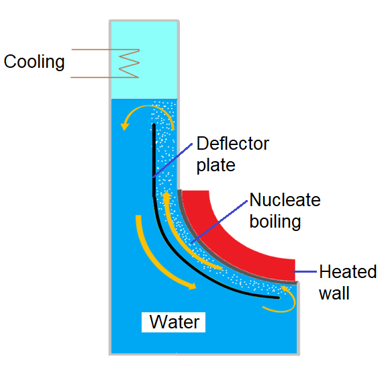
Figure 2: Experimental facility for reactor pressure vessel external cooling investigations
3. Gravity-driven injection from accumulators
Goal: To assess the capability of system and CFD codes to model gravity-driven emergency injection during a loss-of-coolant accident.
System-code simulations will investigate the GRADAC experiment and assess the applicability of gravity-driven injection modelling to entire SMR systems over longer time periods. CFD simulations will focus on local phenomena, including liquid-surface disturbances caused by steam injection, the effect of different sparger configurations, mixing of the warmer upper liquid layer, steam condensation and heat absorption by the surrounding walls.
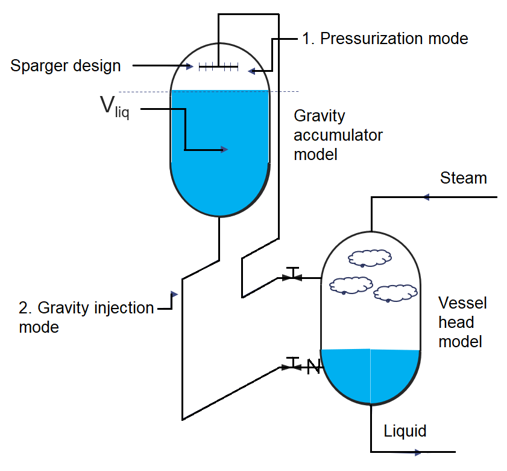
Figure 3: GRADAC facility for gravity-driven accumulator injection experiments
Timeline (1. 3. 2026 – 28. 2. 2029)
The following timeline provides an overview of the main project activities and their planned implementation across the three research topics.
1. Steam condensation in a conventional safety condenser tube

2. Reactor pressure vessel external cooling

3. Gravity-driven injection from accumulators

Project documents
References
General
[1] OECD NEA, The NEA Small Modular Reactor Dashboard: Second Edition, NEA No. 7671, 2024.
[2] Butt H.N., Ilyas M., Ahmad M., Aydogan F., Assessment of passive safety system of a Small Modular Reactor (SMR), Annals of Nuclear Energy 98 (2016) 191–199
[3] Jeon B.G., Bae H., Kim S.H., Yang J.H., Ryu S.U., Yi S.J., Park H.S., Experimental and analytical investigation on SMART passive safety systems for three 2-inch SBLOCA tests using SMART-ITL, Annals of Nuclear Energy 188 (2023) 109835
[4] Mascari F., Woods B.G., Welter K., D’Auria F., Bersano A., Maccari P., Small modular reactors and insights on passive mitigation strategy modeling, Nuclear Engineering and Design 401 (2023) 112088
Modeling of steam condensation in a classical safety condenser tube
[5] Chang S.H., Kim S.H., Choi J.Y., Design of integrated passive safety system (IPSS) for ultimate passive safety of nuclear power plants, Nuclear Engineering and Design 260 (2013) 104– 120
[6] Yang Z., Shan J., Gou J., Preliminary assessment of a combined passive safety system for typical 3-loop PWR CPR1000, Nuclear Engineering and Design 313 (2017) 148–161
[7] Park S.D., Lee D.W., Kang K.J., Park H.-S., Numerical study on the thermal-hydraulic behavior in the ultimate heat sink of passive residual heat removal system in the SMART, Nuclear Engineering and Design 399 (2022) 111997
[8] Chang W., Xiaohui L., Jiaming C., Guanghuai W., Experimental investigation on characteristics of Multiple-Loops coupled natural circulation system, Nuclear Engineering and Design 407 (2023) 112283
[9] Minocha N., Joshi J.B., Nayak A.K., Vijayan P.K., 3D CFD simulations to study the effect of inclination of condenser tube on natural convection and thermal stratification in a passive decay heat removal system, Nuclear Engineering and Design 305 (2016) 582–603
[10] Amidu M.A., Park J., Park Y., Lim C., Jung S., Kim H., Performance analyses of a steam condensation tube immersed in a saturated water pool: Effects of tube inclination, Nuclear Engineering and Design 323 (2017) 142–155
Reactor pressure vessel external cooling
[11] Tusheva P., Altstadt E., Willschütz H.-G., Fridman E., Weiss F.-P., Investigations on in-vessel melt retention by external cooling for a generic VVER-1000 reactor, Annals of Nuclear Energy 75 (2015) 249–260
[12] Whang S., Park H.S., Moriyama K., Lim K., Cho Y.J., Kim M.H., Uncertainty analysis of in-vessel retention in a high power reactor during severe accident, Nuclear Engineering and Design 319 (2017) 1–11
[13] Hu Q., Yan X., Huang S., Yu J., The comprehensive analysis of coolability limits of passive external reactor vessel cooling under in-vessel retention, Annals of Nuclear Energy 120 (2018) 296–303
[14] Amidu M.A., Addad Y., Lee J.I., Kam D.H., Jeong Y.H., Investigation of the pressure vessel lower head potential failure under IVR-ERVC condition during a severe accident scenario in APR1400 reactors, Nuclear Engineering and Design 376 (2021) 111107
[15] Colombo M., Fairweather M., Study of nuclear reactor external vessel passive cooling using computational fluid dynamics, Nuclear Engineering and Design 378 (2021) 111186
[16] Pop A., Petruzzi A., Giannotti W., External function for GOTHIC code to estimate critical heat flux conditions for in-vessel retention assessment, Nuclear Engineering and Design 380 (2021) 111301
[17] Akand M.A.R. , Matsumoto T., Liu W., Morita K., Mechanistic critical heat flux prediction for in-vessel retention conditions, Nuclear Engineering and Design 384 (2021) 111494
[18] Rababah S., Diab A., Evaluation of a hybrid in-vessel retention strategy with ex-vessel cooling for APR1400 under extended station blackout conditions, Nuclear Engineering and Design 429 (2024) 113600
Gravity-driven injection from accumulators
[19] Shiraishi T., Watakabe H., Development of the advanced accumulator for the pressurized water reactor, Nuclear Engineering and Design 249 (2012) 318– 334
[20] Liu X.J., Fu S.W., Xu Z.H., Yang Y.H., Cheng X., LOCA analysis of SCWR-M with passive safety system, Nuclear Engineering and Design 259 (2013) 187– 197
[21] Hu H., Shan J., Gou J., Cao J., Shen Y., Fu X., Simulation of advanced accumulator and its application in CPR1000 LB LOCA analysis, Annals of Nuclear Energy 69 (2014) 183–195
[22] Pouresgandar M., Safarzadeh O., Talebi S., Evaluation of advanced accumulator in a VVER-1000 reactor in loss of coolant accident, Annals of Nuclear Energy 170 (2022) 108988
[23] Cadiou T., Stratta E., Augier L., Multi-Scale study of an innovative safety system for pressurized water reactors, Nuclear Engineering and Design 387 (2022) 111600
[24] Redondo-Valero E., Queral C., Fernandez-Cosials K., Sanchez-Espinoza V., Safety margins improvement by means of the passive second stage hydroaccumulators in a VVER-1000/V320 reactor, Nuclear Engineering and Design 414 (2023) 112644